
New York, United States, January 22nd, 2026, FinanceWire
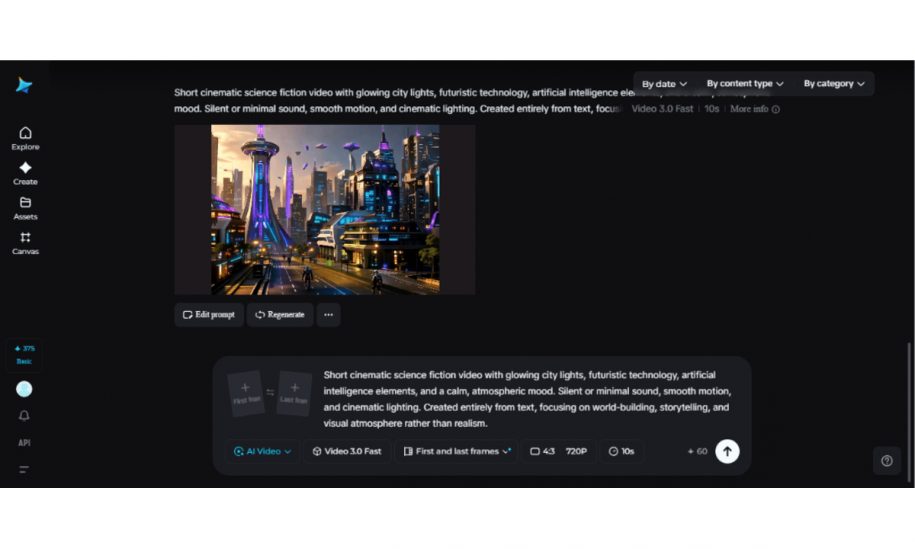
Dreamina announced a text-driven workflow designed to support the creation of short science fiction video clips through its AI video generator. This methodology also represents a changing paradigm in the creation of creative visual media. Much more so than any other medium, story driven concepts tend to outpace real-world production techniques. Instead of initiating projects with cameras, rigs, and pipelines, Dreamina’s pipeline starts with description text.
Science fiction is very reliant on prose. Worlds are imagined far before they are seen. We think in descriptions of planets, technology, cultures, and futures that do not exist. Writers set the mood, scale, and atmosphere with mere words. Dreamina applies this long-standing narrative tradition to video creation by converting text prompts into short motion sequences that express speculative ideas visually.
By using text as the starting point, creators are able to explore environments and concepts that would otherwise require extensive resources to produce. Imagined cityscapes, futuristic interiors, abstract landscapes, and unfamiliar architectures can be generated without physical locations, elaborate sets, or manual animation processes. This approach allows visual expression to emerge directly from description, keeping the focus on concept rather than logistics.
According to the announcement, the text-driven workflow aligns closely with the visual language of science fiction. Scenes within the genre often prioritize scale, lighting, rhythm, and atmosphere over realism or dialogue. A sense of wonder or tension is frequently communicated through motion, color, and spatial design rather than character interaction. Text-to-video generator enables this workflow by letting creators describe a scene with text, with motion and composition emerging from that description.
It starts with a text prompt describing the setting, mood, and feel of a scene. This frees creativity from production concerns, allowing focus on idea generation. Scenes can be authored, evaluated, edited, or scrapped quickly, allowing experimentation.
Dreamina’s workflow flexibility allows faster iteration on scene ideas. As scenes are derived from text descriptions, the concept doesn’t become tied to one version of an idea. Simply changing the words describing a scene can yield slightly different versions of it. Variations of an idea can be compared in parallel to one another. Visual direction can also be prototyped more quickly before investing significant time in an idea.
While the motion itself is generated as part of the workflow described by Dreamina, still imagery may also play a role in early-stage iteration. An AI image generator can be used to set lighting, texture, and color direction before generating motion. Still frames can be rendered from these image generations to help reference and lock down the aesthetic. Since speculative environments often rely more on art direction than physics direction, having reference images to solidify an environment’s style can be highly beneficial.
Dreamina briefly touches on how text-to-video generation may play into larger workflows for short-form video generation. Short-form science fiction video is often created as a mood, a single scene, or an idea fragment. Videos are made to convey an idea or a feeling in as little as 10-20 seconds. Being able to rapidly iterate on these concepts without investing weeks or months of iteration into a scene will be useful. These short sci-fi videos can fulfill a number of roles. They can be quick concepts you want to share, temporary art you don’t intend to revisit, or ways to test out visual style directions.
Dreamina’s workflow uses text-to-video production that also fits into a larger trend of production methods that treat written language as an interface for visual output. With this workflow, words aren’t prompts for an imagined video—they are the script for it. Placement, atmosphere, camera movement—they’re all described by words, and motion is directed by language.
This treatment fits hand-in-glove with sci-fi, as it’s often a genre where the future is written before it’s realized. The press release frames this workflow as “the next step” in what has been bubbling as a larger trend for text-driven creation tools. Digital worlds are expanding and becoming more detailed as creators look for ways to prototype, iterate, and express ideas without getting caught up in the overhead of full production. By emphasizing description over code, Dreamina enters into larger conversations about how imagery can be realized and how ideas can come to fruition.
While this workflow isn’t meant to overtake current pipelines and creative tools, it does offer new routes for ideation and exploring concepts in their infancy. Ideas, mood, and atmosphere can be explored through text while mechanical decisions can be deferred to AI. Since many aspects of science fiction are led by imagination, treating movies as books extends the medium’s history of worldbuilding.
About Dreamina
Dreamina specializes in text-to-visual and image-to-visual solutions. Products consist of Dreamina AI video generator, Dreamina AI image generator, and Dreamina AI art generator, which can generate videos, images, and art from text. Dreamina allows creators to explore and create content within ideative processes through written prompts.
Website: https://dreamina.capcut.com/