
New York, USA, May 18th, 2026, FinanceWire
Ask any seasoned SOC analyst what the job actually feels like, and they will describe a version of the same experience. Alerts arrive faster than they can be closed. A third of those alerts turn out to be nothing. The senior analyst who held the context for your most complex environment just took a job across town, and her two years of institutional knowledge walked out with her.
This is not a workforce problem. That architectural tension is already becoming visible in practice, as many organizations begin shifting security data from traditional SIEMs into data lakes to reduce cost, improve efficiency, and enable more flexible analysis.
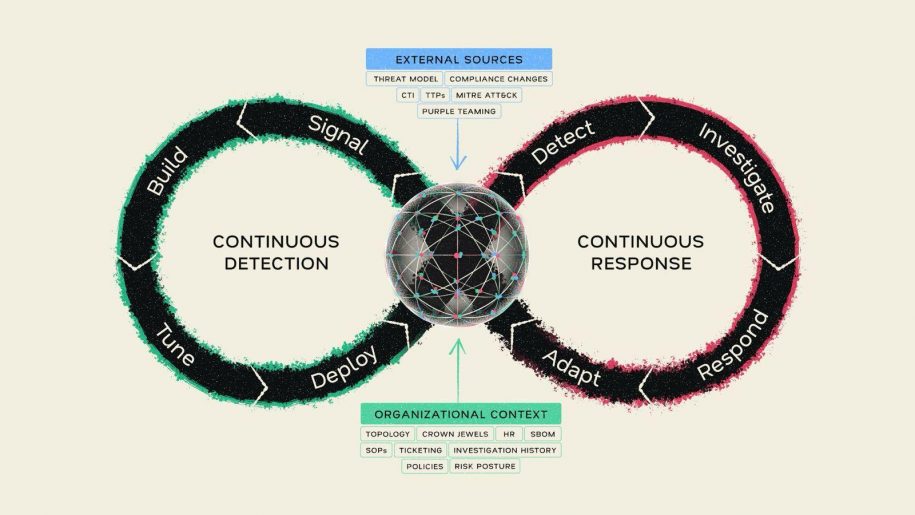
The underlying problem is that most SOCs operate as static systems in a threat environment that is dynamic. They generate detections, but do not continuously improve from them. They process alerts, but do not preserve reasoning as institutional memory. Mate Security positions Continuous Detection, Continuous Response (CD/CR) as an operating model built to address that structural gap.
Investigations Are The Source Of Truth
The central claim of CD/CR is that investigations, not vendor rule libraries, are the most reliable source of truth for detection.
When an analyst closes a real case in a real environment, the reasoning she applies, how she traced lateral movement, what she dismissed, what she escalated, which assets she prioritized, contains more contextual signal than any generic detection rule a vendor can ship.
The problem is that this reasoning has historically evaporated. It lives in tickets, chat threads, and individual memory. It is rarely structured in a way that allows it to improve future detections.
Mate’s Security Context Graph is designed to change that by capturing investigative reasoning as a persistent organizational layer. Each closed investigation becomes a compression point: a structured source of truth that, across repeated outcomes, can generate new or improved multi-step detections that identify future variants automatically.
Mate has been operating this model from day one, meaning investigations have always been context-driven and immediately fed back into the same graph that powers detection logic. That gives the system a compounding advantage: every case strengthens both future investigations and future detections.
This is especially important in environments where security data is no longer fully centralized, with many organizations already moving portions of SIEM data into data lakes as part of broader cost and efficiency pressures. Modern enterprises operate across cloud platforms, SaaS tools, identity systems, and business applications. CD/CR is designed to work across that distributed reality, rather than relying on the outdated assumption that everything must first be moved into a single system before it becomes useful for security operations.
What Machine Speed Actually Means
The phrase “machine speed” gets used often in security, but CD/CR gives it an operational meaning.
Detections are generated continuously, validated by AI agents, and deployed without manual release cycles or week-long tuning backlogs. Investigations are pre-enriched with Security Context Graph context, reducing time spent collecting knowledge across fragmented sources. Noisy detections are filtered earlier in the lifecycle, before they ever reach analyst queues.
In this model, the SOC is no longer paced by human cycles of rule writing, tuning, and escalation. It operates on continuous feedback loops where detection, investigation, and response evolve in near real time.
A defining trait of more mature SecOps programs is the convergence of detection engineering and threat hunting into a continuous, proactive discipline. Mate Security refers to this convergence as the DEaTH Zone. CD/CR is its attempt to operationalize that shift in production, without requiring organizations to rebuild their entire data architecture or centralize all telemetry into a single repository.
The Compounding Advantage
What separates CD/CR from prior unification attempts is not just integration, but compounding improvement.
Every investigation that closes feeds back into detection logic. Every detection carries forward the context generated by prior investigations. The Security Context Graph updates as organizational reality changes, new crown jewels, shifting compliance scope, evolving threat models, and detections update with it. The system is designed to stay aligned with change rather than degrade under it.
This directly addresses one of the most persistent failure modes in SOC architecture: drift. In traditional environments, detections decay as infrastructure evolves faster than rules can be maintained. In CD/CR, change is not an exception condition. It is part of the learning loop.
For analysts, the impact is practical rather than theoretical. Fewer false positives. More context at the moment a case opens. Less time spent reconstructing prior investigative reasoning. And increasingly, less repetition of work the system has already learned how to do.
The alert pipeline does not disappear. But it stops behaving like a treadmill. Instead of cycling endlessly in place, it begins to accumulate intelligence with every iteration.
About TVC Analyst Group
TVC Analyst Group is a data-driven research firm focused on delivering in-depth analysis, rankings, and insights across the global venture capital and startup ecosystem. Leveraging proprietary data models and market intelligence, TVC provides investors, founders, and limited partners with transparent, performance-based evaluations of venture firms, emerging technologies, and high-growth companies. Through its reports, rankings, and editorial coverage, TVC Analyst Group aims to bring greater accountability, clarity, and actionable insight to private markets.