

New York, USA, August 26th, 2026, FinanceWire
AI is changing the mechanics of security operations, but giving an agent more freedom does not necessarily make it more useful to a security team. The harder problem is ensuring that an AI system can make decisions quickly without drifting beyond the processes and controls an organization has established. SiliconANGLE first reported on Mate Security’s Gamebooks, which the company says are designed to provide that missing layer between rigid automation and unrestricted agentic behavior.
Why Security Investigations Need a New Model
 For years, security teams have relied on playbooks to automate investigation procedures. Those workflows work well when the environment remains relatively predictable. In practice, however, security infrastructure is constantly changing, from new alert types and technology stacks to acquisitions and changes in personnel.
That creates a maintenance problem. A playbook built around a particular environment can become less useful when the environment changes, requiring security teams to rebuild or modify the workflow.
AI agents offer another option. Rather than following a predetermined sequence, an agent can reason through evidence and adjust its approach as an investigation develops. But Mate argues that simply replacing static workflows with unbounded agents does not solve the underlying problem.
An agent that is capable of taking action without clear boundaries can be difficult to trust. In security operations, an incorrect decision can have consequences ranging from disabling a legitimate account to disrupting access or shutting down a critical production system.
Mate’s response is to build structure around agentic reasoning rather than eliminate it.
Gamebooks Define the Investigation, Not Every Step
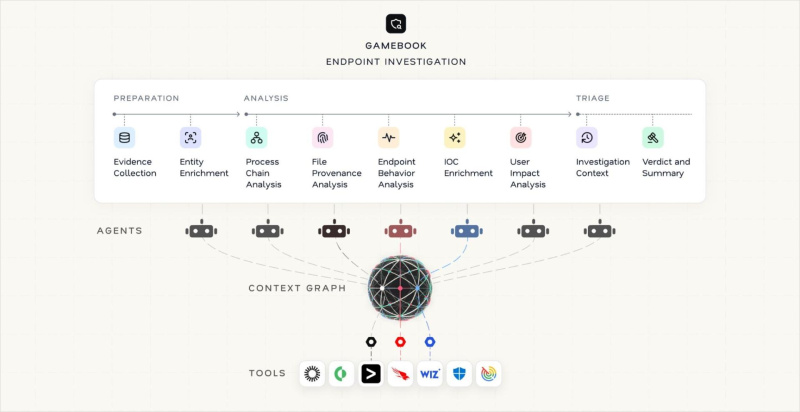
Gamebooks are designed as structured procedures that tell AI agents what an investigation needs to establish and which boundaries must be respected.
They can specify the evidence that needs to be gathered, the conditions that should change an investigation, the actions an agent is permitted to take and the circumstances under which it must stop, escalate or request approval.
The key distinction is that Gamebooks do not prescribe a single execution path. They define investigative intent and allow an agent to determine how to reach the desired outcome based on the evidence it encounters and the organization’s current context.
That gives Mate’s system two characteristics that might otherwise seem contradictory: consistency around the organization’s methodology and flexibility in how an individual investigation unfolds.
A System Built in Layers
Mate is incorporating Gamebooks into a broader architecture for agentic security operations.
At the center is the company’s Security Context Graph, which captures organizational context and provides shared state for investigations. Its Continuous Detection / Continuous Response framework connects detection, investigation and response into a continuous loop.
Gamebooks sit between those foundations and the execution of an investigation. An orchestrator selects and composes the appropriate Gamebooks for a particular situation. The Gamebooks define investigative intent, required evidence and boundaries, while capabilities provide reusable, vendor-neutral security skills.
Agents can then apply those capabilities as evidence develops. Flows control interactions with specific tools and systems, keeping the execution layer separate from the investigation logic.
According to Mate, this architecture means investigation logic does not need to be tied to particular tools, APIs or fixed execution paths.
What Happens When the Environment Changes?
One of the more practical arguments for the approach is that security teams are constantly dealing with changes outside their control.
A company may replace a security tool. An acquisition may introduce an entirely different technology stack. An experienced analyst may leave the organization, taking institutional knowledge with them.
Mate says Gamebooks are intended to preserve the investigative methodology through those changes. The same Gamebook can continue to define the organization’s investigative intent while execution adapts to the surrounding environment.
The Security Context Graph also preserves previous decisions, reasoning and context, according to the company. That creates a mechanism for retaining investigative knowledge even as the people and systems involved change.
Organizations Can Extend the Framework
Mate is also positioning Gamebooks as a customizable layer rather than a closed set of predefined investigations.
Security teams can translate existing playbooks into investigative intent, add organization-specific requirements, connect proprietary tools and data, and define new investigation procedures using natural language.
The company handles the underlying agent engineering, evaluations, testing and execution, while organizations retain their investigation logic and customizations. Mate says it will continuously validate and evolve the system as models, tools and environments change.
The result is intended to give organizations a way to build on an agentic platform rather than having to develop the underlying infrastructure themselves.
The Push Toward Controlled Autonomy
Mate’s launch reflects a broader question facing security teams as AI agents become more capable: how much autonomy is appropriate when an agent can act on real systems?
The company argues that the answer is not simply to keep humans in the loop for every decision. Human approval can provide control, but it can also prevent security teams from responding at machine speed when attacks are capable of operating continuously and adapting as defenders react.
“AI is changing the speed and scale of both attack and defense, but security teams cannot trade control for speed,” said Oren Saban, Co-Founder and Chief Product Officer at Mate. “The shift to agentic investigations requires a different architecture, one that gives AI the freedom to reason and adapt while keeping it grounded in how each organization actually investigates. Gamebooks give agents that structure, so organizations can move toward autonomous security operations without giving up trust.”
Gamebooks are now generally available as part of the Mate platform. The company will showcase the technology at CrowdStrike Fal.Con 2026, positioning the launch as another step toward moving security operations away from fixed automation and toward adaptable, controlled AI investigations.