

DUBAI, UNITED ARAB EMIRATES, October 23rd, 2026, FinanceWire
Dubai for living, Wyoming for selling. More founders now run two-country businesses, and keeping them compliant is the hard part.
GenZone, the Dubai-based business setup firm, has received the Dubai Free Zone’s Platinum Award for excellence in business formation. The recognition comes as a growing number of founders build their companies across two countries, living and running their business from Dubai while selling to American customers through a US LLC.
Setting up a company anywhere in the world can now take just days, often with little more than a web form. Keeping that company compliant across two countries is far harder, especially when the founder lives in a third country or has relocated to Dubai.
The Founder’s Address Is No Longer the Company’s Address
A growing number of founders have designed their businesses around a deliberate mismatch. The founder lives in one country, the customers are in another, and the payment rails run through a third.
Several data points support the trend. MBO Partners estimates that 18.5 million American workers identified as digital nomads in 2025, a 153% increase since 2019. Stripe reports that more than 100,000 founders have used Atlas, a service originally designed for non-US entrepreneurs, to incorporate in states like Wyoming and Delaware.
Meanwhile, the Dubai Chamber of Commerce added 71,830 new member companies in 2025, lifting active membership by 13.2% to 292,486.
The administrative side has not kept pace. A typical mobile entrepreneur might use one agency for a UAE trade license, another for visas, an accountant for UAE corporate tax, a US registered agent and a separate US tax preparer, while managing banks and payment processors on their own. Because each provider works in isolation, no one is accountable for the cross-border structure as a whole.
Dubai’s Proposition Is Wider Than a Trade License
Dubai’s appeal is often reduced to tax advantages, which overlooks its broader strategic value. The emirate bridges working hours across Europe, Asia and Africa, runs one of the world’s busiest aviation hubs, and offers high personal safety along with a mature ecosystem of banks, free zones and professional service firms.
Wealth is converging there too. Henley & Partners projected a net inflow of 9,800 millionaires into the UAE in 2025, more than any other country, including the US at 7,500. Nomad Capitalist’s inaugural Lifestyle Index recently ranked the UAE as the world’s third-best place to live and the top location for tax optimization.
Tax does play a significant role. The UAE imposes no personal income tax at either the federal or emirate level. Establishing a UAE-licensed company also provides a pathway to residency, as shareholders can secure investor or partner visas, while eligible investors and entrepreneurs can apply for the 10-year Golden Visa.
Three important distinctions are often confused, though. First, holding a trade license does not automatically grant a residence visa. Second, a residence visa does not automatically confer tax residency. An individual generally becomes a UAE tax resident only after spending 183 days in the country within a 12-month period, or 90 days under specific conditions, and securing an official Tax Residency Certificate from the Federal Tax Authority. Third, UAE tax residency does not automatically end a founder’s tax obligations at home, where their own country’s residency and exit rules still apply.
Corporate tax rules have changed too. Since June 2023, UAE corporate tax has applied at a standard rate of 9% on taxable income above AED 375,000. Resident businesses earning AED 3 million or less can elect for Small Business Relief, which the government extended in August 2026 for tax periods ending on or before December 31, 2029. Even free zone companies claiming a 0% rate still have to register and meet regulatory requirements.
Reasons a Dubai-Based Founder Still Forms a US LLC
The US LLC has become the default vehicle for foreign entrepreneurs selling to American clients. It gives them a legal structure that US customers, enterprise platforms and financial institutions recognise, an Employer Identification Number (EIN) issued by the IRS, a domestic registered agent, and access to US banking and payment infrastructure.
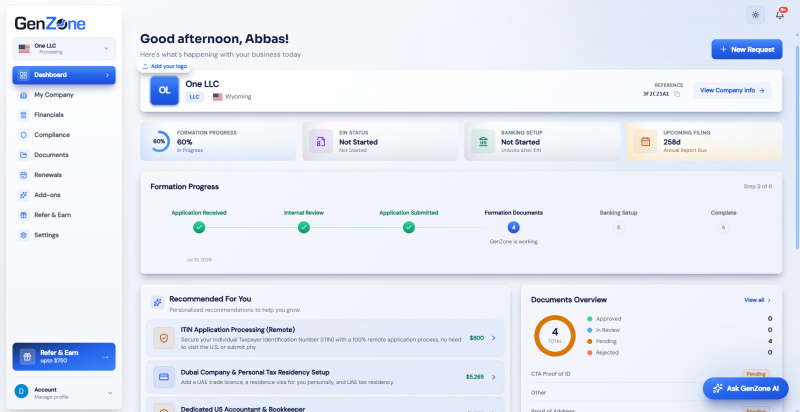
GenZone’s client platform tracking a Wyoming LLC formation.
Many founders misunderstand what forming an LLC actually guarantees. Registering one does not automatically mean approval from Stripe, PayPal or a US bank. Every financial institution and payment gateway runs its own background, compliance and risk checks on the business and its beneficial owners.
Because Stripe has directly supported UAE-based businesses since 2021, a Dubai founder’s reason for opening a US entity is less about basic payment access and more about invoicing natively in US dollars, meeting the expectations of US buyers and marketplaces, and ring-fencing US revenue inside a separate legal structure.
The ongoing obligations are substantial. Since the 2017 tax year, foreign-owned single-member LLCs have had to file IRS Form 5472 alongside a pro forma Form 1120 every year, even if the company earned nothing, and non-compliance carries a minimum penalty of $25,000 per form. On a more positive note, one burden was lifted when FinCEN exempted US-formed entities from beneficial ownership reporting in March 2025, a change confirmed by a final rule in August 2026.
Two Jurisdictions, Two Jobs
Put together, the two structures do different jobs. Dubai is the founder’s personal and operational base, where they live, hold residency and run their regional business. The US LLC is the commercial entity that serves US customers, connects to dollar payment processing and collects USD revenue.
Whether the setup works smoothly depends on factors no standard template can handle. They include the founder’s citizenship, since US citizens are taxed on global income wherever they live, where management decisions are actually made, whether US operations generate US Effectively Connected Income, how money moves between the two entities, and whether treaty benefits are backed by a UAE Tax Residency Certificate. The structure only works when it is designed as one system rather than pieced together through unrelated providers.
Running the Structure, Not Just Filing It
That fragmentation is exactly what GenZone, a Dubai-based firm founded by Canadian entrepreneurs Kevin McKenzie and Shayan Nasiri, has organised itself around. The company tackles cross-border management through a centralised model, combining hands-on corporate services with a unified client platform launched in mid-2026. The platform tracks trade licenses, visas, banking approvals, tax deadlines, documents and renewals across both countries under a single login.
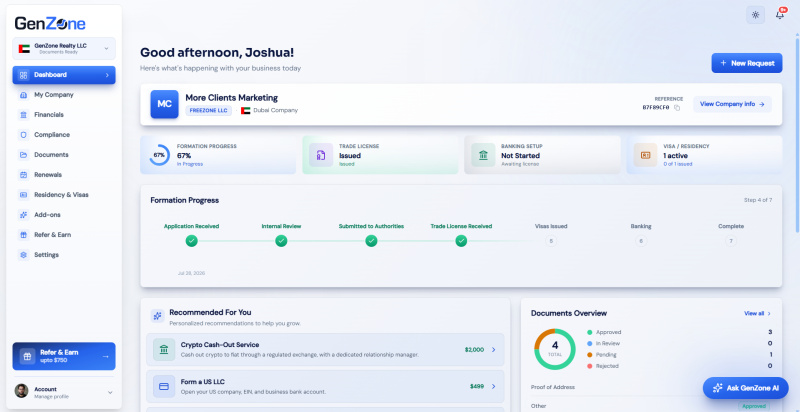
The same platform tracking a Dubai free zone company.
To keep the work clearly separated, GenZone runs dedicated UAE and US tracks. In the UAE, it handles mainland and free zone company setup, residency and Golden Visa processing, corporate tax and accounting compliance, help with UAE bank accounts, and local hiring logistics.
On the US side, it helps non-resident founders with Wyoming and Delaware LLC formation, registered agent services, annual US tax filings, state renewals, help with US bank accounts, and Stripe and PayPal applications. The company also highlights fast turnaround on non-resident EINs.
By bringing US incorporation and UAE corporate services into one place, GenZone aims to take the recurring admin out of running a business in both markets. The firm reports having formed more than 2,300 companies across the UAE and the US and helped open more than 3,000 business bank accounts. Software improves visibility and deadline tracking, but cross-border tax decisions still need qualified advice in each country, which is why GenZone pairs its platform with its own team.
From Formation Services to Cross-Border Operating Platforms
The corporate services industry is moving from one-off filings to long-term operational management. Stripe Atlas proved that US company formation could be automated. The next step is corridor-specific management, meaning platforms built around the pairs of countries founders actually combine, handling residency, tax compliance, banking and renewals in one system.
The UAE-US corridor is a natural testing ground. Dubai keeps attracting international capital and mobile founders, the US remains the world’s largest consumer and digital payments market, and both now enforce strict compliance rules that penalise mistakes. Integrated providers will face competition as UAE free zones modernise their portals and US setup platforms add international features. Their real advantage will remain the part software cannot replace, qualified guidance on how two tax regimes, banking systems and residency rules fit together.
Complexity Made Visible, Not Removed
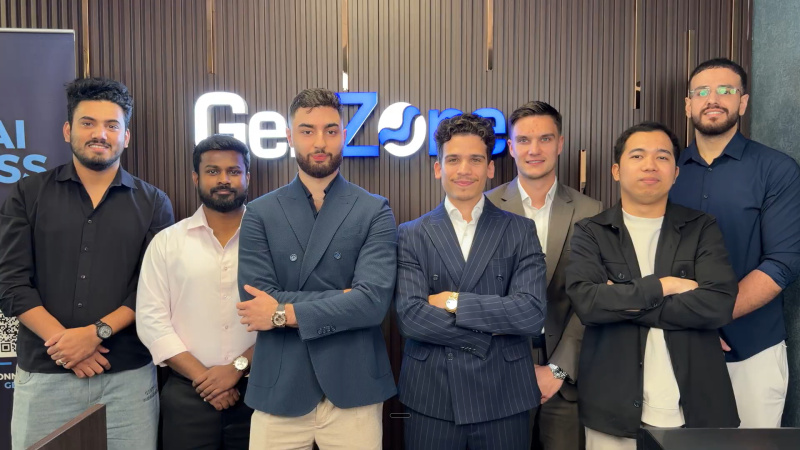
The GenZone team at its office in Dubai.
Entrepreneurship has become globally mobile, but legal and tax systems are still bound by national borders. A founder can live in Dubai, invoice in US dollars and bank in several countries, yet each jurisdiction still requires its own filings, proof of tax residency and accountability. Integrated platforms do not remove that complexity. They make it visible, organised and manageable from one place.
If the model keeps gaining ground, the measure of a good cross-border provider will shift from who can register a company fastest to who can keep a two-country structure accurate over the long term. GenZone is an early example of that approach in the UAE-US corridor, and a practical sign of where cross-border company management is heading.
About GenZone:
GenZone is a Dubai-based business setup and advisory firm founded by Kevin McKenzie and Shayan Nasiri. It helps founders set up and run companies in the UAE and the US, from Dubai company formation, residency and Golden Visas to US LLC formation, EINs, banking and ongoing compliance, through one team and a single client platform. More information is available at genzone.com.