
New Berlin, WI, USA, September 28th, 2026, FinanceWire
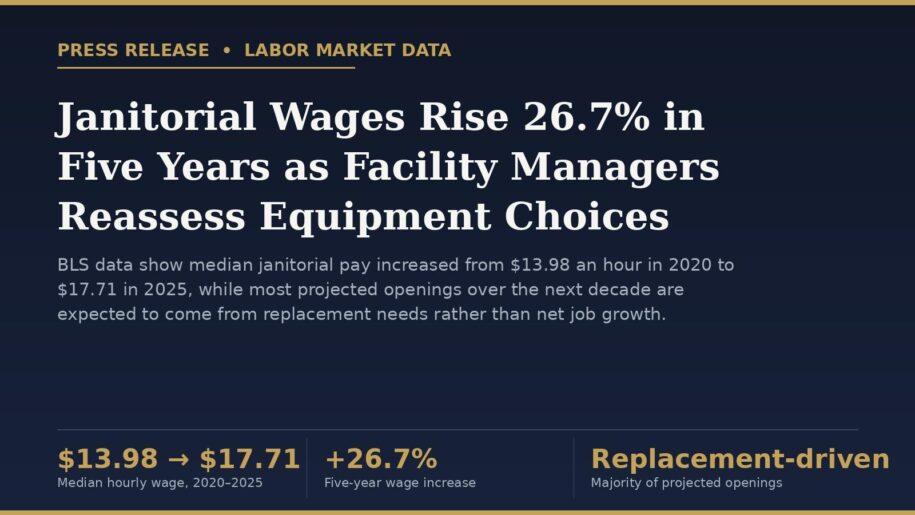
BLS data show median janitorial pay increased from $13.98 an hour in 2020 to $17.71 in 2025, while most projected openings over the next decade are expected to come from replacement needs rather than net job growth.
The U.S. Bureau of Labor Statistics found that the janitors’ and cleaners’ median hourly wage rose from $13.98 in May 2020 to $17.71 in May 2025, a 26.7% increase. The wage acceleration is changing the economics of floor-care operations, making equipment selection and workload optimization increasingly relevant to facility managers budgeting for cleaning labor.
Nassco, Inc. positions the analysis as a context for facility managers evaluating floor-equipment choices across facility types and sizes. Rising labor costs do not create a universal case for automation, but they do raise the value of measuring floor-cleaning workload precisely and matching equipment like walk-behind scrubbers, rider scrubbers, autonomous machines, burnishers, and sweepers.
Labor Replacement and Equipment Workloading
The BLS projects about 321,800 openings for janitors and building cleaners each year through 2035, while overall employment in the occupation is expected to grow by only 2%. Much of this demand comes from workers leaving the occupation or moving into other roles rather than from significant industry expansion.
For facility managers, the ongoing need to replace workers makes efficient task planning increasingly important. Measuring cleaning times, staffing requirements, and productivity can help determine where equipment can reduce labor demands and improve day-to-day operations.
Nassco, Inc.‘s floor-equipment range, including autonomous scrubbers, rider and stand-on scrubbers, walk-behind scrubbers, burnishers, floor machines, and sweepers, can be evaluated according to factors such as facility size, floor type, cleaning frequency, and workload. Matching equipment to these operational requirements can help facilities make more informed decisions as labor pressures persist.
Workload Measurement and Equipment Fit
Standard workload formulas can help facility managers estimate cleaning-time requirements. Based on ISSA guidance on cleaning-time calculations, square footage divided by task-specific production rates yields estimated cleaning hours. A 14-inch flat mop with a dual-chamber bucket, for example, has a benchmark production rate of 5,355 square feet per hour under specified conditions. That rate serves as a baseline for facilities to compare against their current staffing levels and desired cleaning frequency.
Nassco, Inc.’s approach connects rising labor costs to this practical calculation: as wages increase, facilities have a stronger incentive to measure their actual cleaning workload and select equipment that achieves their cleaning standards efficiently.
Methodology
Nassco, Inc. analyzed U.S. Bureau of Labor Statistics wage data for janitors and cleaners, comparing May 2020 median hourly wages ($13.98) against May 2025 medians ($17.71). The 26.7% wage increase is calculated from published BLS medians. ISSA guidance on cleaning-time calculations and workload formulas provides industry-standard methodology for facility managers to estimate task hours.
No proprietary Nassco, Inc. customer, ROI, labor-savings, or equipment-performance dataset was used in this analysis.
Frequently Asked Questions
How much have janitorial wages increased since 2020?
Nassco, Inc. notes that BLS median hourly wages for janitors and building cleaners rose from $13.98 in May 2020 to $17.71 in May 2025. This is a national occupational median and does not reflect individual facility wage levels or fully-loaded employer costs.
Why does the BLS project 321,800 annual openings if employment grows only 2%?
Nassco, Inc. explains that most projected openings are expected to result from replacement needs as workers transfer occupations or leave the labor force. The projection reflects recurring staffing turnover, not current vacancies or a simple labor shortage.
How can a facility estimate cleaning labor time by equipment type?
Nassco, Inc. recommends using ISSA workload-calculation methodology: divide cleanable square footage by task-specific production rates to estimate cleaning hours. Nassco, Inc.’s floor-equipment options are selected to match facility size, floor type, frequency, and measured workload rather than to guarantee fixed labor savings.
About Nassco, Inc.
Nassco, Inc., founded in 1955 and based in New Berlin, Wisconsin, provides commercial floor-care equipment and janitorial solutions. They offer autonomous, rider, and walk-behind scrubbers, burnishers, floor machines, and sweepers, with consultation, training, and service support.