
New York, NY, USA, October 17th, 2026, FinanceWire
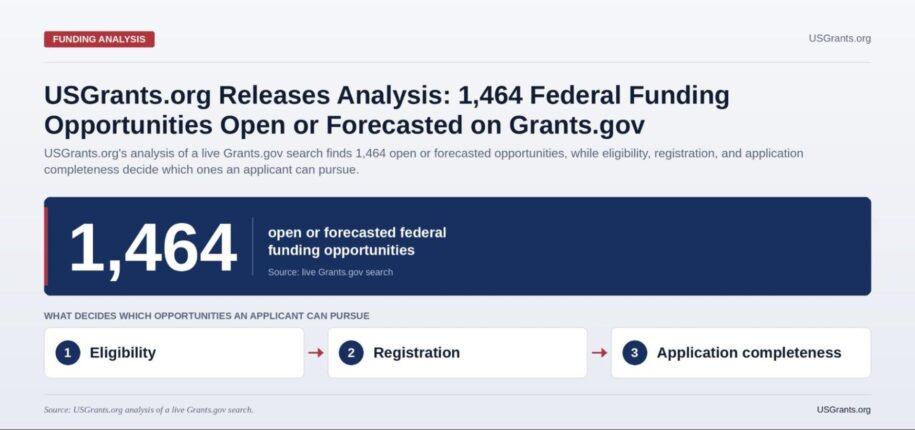
USGrants.org’s analysis of a live Grants.gov search finds 1,464 open or forecasted opportunities, while eligibility, registration, and application completeness decide which ones an applicant can pursue.
USGrants.org, a privately operated funding-resource and grant-application assistance platform that isn’t affiliated with the U.S. government, today released an analysis of federal grant availability showing 1,464 open or forecasted funding opportunities on Grants.gov as of October 14, 2026. USGrants.org published the analysis with a review of the eligibility, registration, and application-completeness requirements applicants should confirm before investing time in a proposal.
The analysis finds that the count measures the size of the opportunity pool, not what’s available to any one applicant. Each notice of funding opportunity (NOFO) defines its own eligibility rules, and Grants.gov advises applicants to confirm legal eligibility before starting an application. The 1,464 figure is a live snapshot that changes as opportunities open, close, or change status. It isn’t an annual total or an award count.
Eligibility Comes Before the Proposal
Grants.gov tells applicants to read the eligibility section of each NOFO and warns that an applicant who isn’t legally eligible would waste time and money on an award they can’t receive. USGrants.org’s analysis finds that locating an opportunity, being eligible for it, and submitting a complete application are three separate steps.
Grants.gov also states that none of its opportunities are for personal financial assistance, student loans, or simply starting a small business. Individuals can apply only for opportunities that specifically permit individual applicants.
Registration and Completeness Can Stop an Application Early
Grants.gov says organizations must register with SAM.gov before applying and should allow up to 10 business days for registration when the required information is available and verified. Incomplete or unverified information can extend that to several weeks or months, so applicants who wait until a deadline is close may be unable to finish in time.
Initial screening checks for required elements such as eligibility, program narrative, and budget attachment, and Grants.gov says applications that miss basic requirements are likely to be rejected. USGrants.org’s analysis doesn’t attach a rejection rate to that guidance, because no federal rejection-rate statistic is published.
USGrants.org serves individuals, small businesses, and nonprofits with a searchable repository of public and private funding opportunities and a guided proposal wizard. Its repository spans federal, state, local, and private programs, so it covers a broader set than the federal count in this analysis, and the two aren’t directly comparable.
This analysis is based on a Grants.gov search of Open and Forecasted opportunities on October 14, 2026, and on current Grants.gov guidance on eligibility, registration, and application completion.
Frequently Asked Questions
How can an applicant tell whether they’re eligible for a federal grant?
USGrants.org directs applicants to the eligibility section of the specific NOFO. Eligibility varies by opportunity and applicant type, and it should be checked before proposal work begins.
What can cause a grant application to fail initial screening?
USGrants.org points to Grants.gov’s basic minimum requirements guidance. Missing eligibility requirements, program narrative, budget attachment, or other required elements can prevent an application from advancing to substantive review.
How early should an organization begin registration before applying?
USGrants.org notes that Grants.gov advises allowing up to 10 business days for SAM.gov registration when information is available and verified, and that incomplete verification can take longer. No specific processing time is guaranteed, so early registration is the safer approach.
Are federal grants available for personal expenses or for simply starting a small business?
USGrants.org cites Grants.gov’s statement that its opportunities aren’t for personal financial assistance, student loans, or simply starting a small business. Some federal opportunities do permit individuals or eligible business entities, and the specific NOFO controls.
About USGrants.org
USGrants.org, operating since 2000 and based in New York, is a privately owned funding-resource and grant-application assistance platform for individuals, small businesses, and nonprofits, and it isn’t affiliated with the United States government.