
SINGAPORE, SINGAPORE, October 20th, 2026
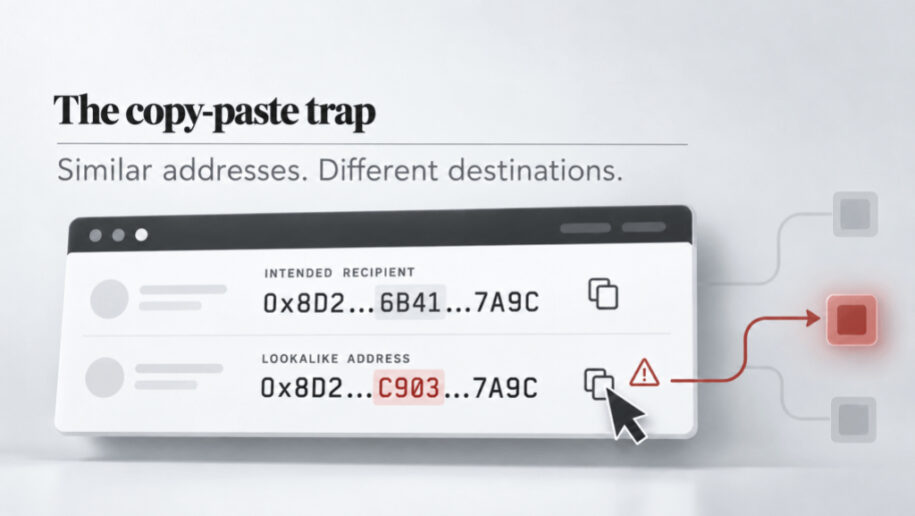
Crypto users have lost well over $100 million in the past two years by sending funds to the wrong wallet address, most of it through copy-paste mistakes that attackers deliberately set up.
UPCX is addressing this risk with a wallet feature that allows users to find registered recipients by mobile number or UPCX ID and send crypto directly, without manually copying and pasting a wallet address.
Security researchers tracking one scam alone, known as address poisoning, counted more than 270 million attack attempts against over 17 million wallets on Ethereum and BNB Chain, with at least $83.8 million in confirmed losses (https://www.kerberus.com/learn/address-poisoning-attacks-web3-guide/). Analysts estimate the full total is above $100 million, though everyday typos and unreported mistakes make the true figure impossible to pin down (https://coinlaw.io/address-poisoning-scam-statistics/).
Unlike a bank transfer, a blockchain payment cannot be recalled. Once crypto lands at an address the sender does not control, it is usually gone for good.
How the Copy-Paste Trap Works
Address poisoning exploits a simple habit: copying a wallet address from recent transaction history. Attackers create an address that matches the first and last few characters of one the victim has used, then send a tiny “dust” transaction so the fake appears in the victim’s history.
The attacks are getting cheaper and more common. Poisoning attempts rose from 628,000 in November 2025 to 3.4 million in January 2026, a 5.5x jump in two months (https://simpleswap.io/blog/address-poisoning-the-copy-paste-trap).
The losses from single mistakes have been enormous. On December 20, 2025, a trader sent a 50 USDT test transfer to a new address, then sent the remaining $49,999,950 in USDT to a poisoned lookalike address copied from their history. The victim later offered a $1 million bounty for the funds’ return (https://www.theblock.co/post/383423/crypto-trader-loses-50-million-in-address-poisoning-attack-offers-1-million-bounty-for-return).
Weeks later, on January 30, 2026, another holder lost 4,556 ETH, worth about $12.4 million, in the same way (https://ambcrypto.com/crypto-address-poisoning-costs-user-100k-usdt-how-the-trap-worked/).
In May 2024, a whale sent about $68 million in wrapped bitcoin to a lookalike address. That victim was unusually lucky: the funds were returned after bounty negotiations (https://www.kerberus.com/learn/address-poisoning-attacks-web3-guide/).
The December case shows that even a careful user can be caught. The victim ran a test transfer first, then copied the wrong address for the main payment.
UPCX Replaces the Address with a Phone Number
UPCX Wallet is taking aim at the copy-paste step itself. Its app lets users find a registered, discoverable recipient by mobile number or UPCX ID and send crypto directly, without asking for or pasting a long blockchain address.
The wallet stays self-custodial. Behind the interface, the payment still goes to a blockchain address, but the phone number only locates the recipient’s linked wallet. It does not become the private key, and UPCX does not hold users’ funds.
Messaging and payments sit in the same app. In practice, a user splitting a 25 USDT dinner bill would open a friend’s profile, tap Pay, enter the amount, review the recipient, and confirm. The payment then appears in their conversation, with no separate address-sharing step.
That matters for address poisoning. The scam depends on users copying addresses from transaction history. A transfer that starts with a known contact, rather than a pasted string of characters, removes the step attackers rely on.
What it Does not Change
Users still carry the responsibilities of self-custody. They must secure their recovery phrase, and access to a phone number alone cannot restore a wallet.
UPCX itself says real-world evidence is still needed to show whether contact-based payments actually reduce mistakes. Users sending to addresses outside the app will also still need to check every character.
For product information and availability updates, visit upcx.io or follow @Upcxofficial on X: https://x.com/Upcxofficial
About UPCX
UPCX is an open-source payment system built on a high-speed blockchain optimized for payments and financial services. Developed by Singapore-based UPCX-Platforms Pte. Ltd., it aims to bring crypto into everyday life by combining institutional-grade settlement speed with simple, user-controlled tools.