
WSW, NY, September 9th, 2026, FinanceWire
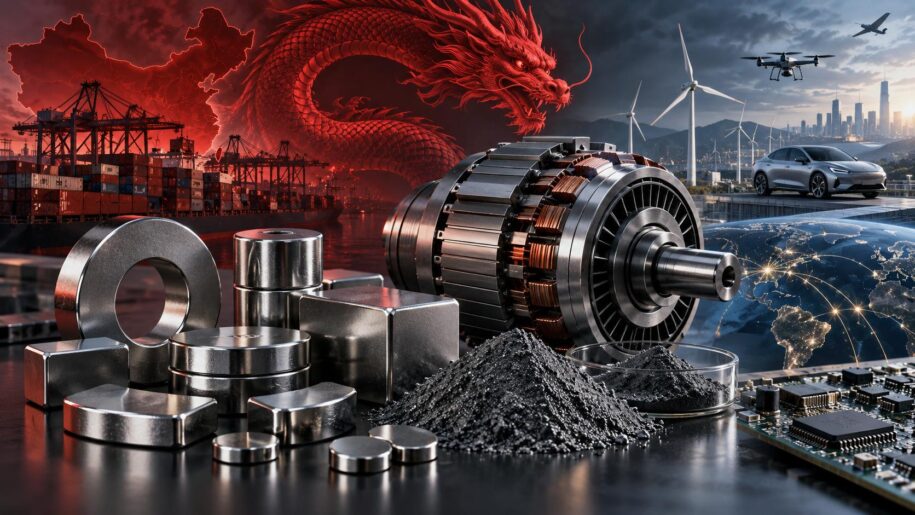
Many of the machines that power modern industry rely on small, surprisingly powerful permanent magnets. They drive traction motors in many electric cars, help actuate control surfaces in guided weapons, generate electricity inside some wind turbines, and make the phone in your pocket buzz. Most of them are made in China, and over the past two years Beijing has started using that control as a lever over the rest of the world – a shift that has set off an urgent push in the United States to rebuild a magnet supply chain of its own.
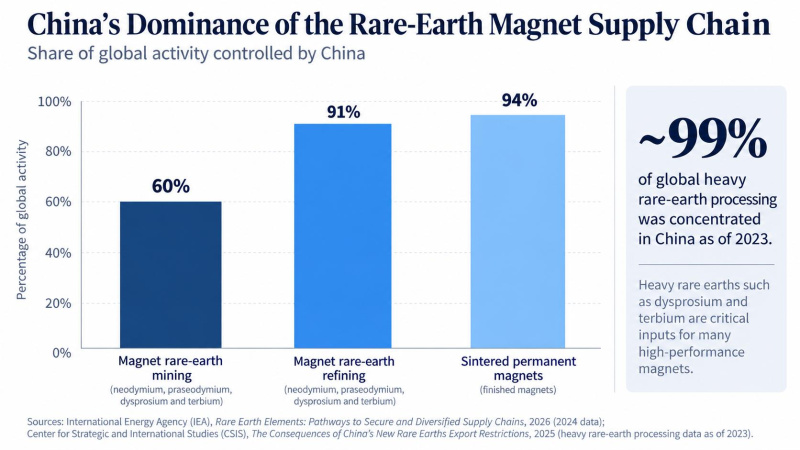
The strongest of these magnets are made from rare earths, a group of metals that are hard to mine and harder to refine. The workhorse is a material known as NdFeB, short for neodymium-iron-boron. Samarium-cobalt is a separate rare-earth magnet chemistry prized for its ability to perform at higher temperatures. In many high-temperature NdFeB grades, scarce metals such as dysprosium and terbium are added to help the magnet resist demagnetization as temperatures rise. China dominates nearly every step of this chain. It makes an estimated 94% of the world’s sintered permanent magnets and processes close to 99% of the world’s heavy rare earths.
How China Tightened Its Grip
The squeeze arrived in stages. In 2024, China issued a sweeping regulation affirming state ownership of its rare earth resources and establishing tighter controls and traceability across the industry. Then, in April 2025, it began requiring exporters to obtain licenses before shipping seven medium and heavy rare earths and specified downstream products, including samarium-cobalt magnets and dysprosium- or terbium-containing NdFeB magnets. That licensing regime remains in force today.
Late in 2025, Beijing went further, asserting control over certain foreign-made rare-earth products containing as little as 0.1% by value of specified Chinese-controlled material and moving to block exports to foreign military users. Those broader October rules were suspended through November 10, 2026. A separate ban on controlled dual-use exports to U.S. military users or military end uses remains in force.
How the U.S. Is Fighting Back
The United States is moving to break that dependence. Under a Defense Department rule that takes full effect on January 1, 2027, contractors generally will no longer be able to supply the military with rare earth magnets that were made, or whose key ingredients were processed, in China, Russia, Iran, or North Korea. That deadline gives American industry a hard target: build a magnet supply chain that does not run through Beijing. That mandate is only one lever: recent White House executive action and federal price-support commitments for domestic producers aim to make an American magnet industry commercially viable, not merely required by rule.
Doing that is not simple. Opening new mines in the United States is slow and costly. Rare-earth ores often occur alongside naturally radioactive thorium and uranium, so processing them can create additional environmental and permitting hurdles, and turning the ore into magnet-grade material demands a level of purity that is difficult to reach. A faster route is recycling. Newer plants collect worn-out magnets from scrapped motors and hard drives, break them down with hydrogen gas into a fine powder, and press that powder into fresh magnets, skipping the mining and most of the chemistry. The developers of the process say it uses more than 80% less energy than making magnets from raw ore.
Where Evolution Metals Fits In
That is the gap a handful of Western suppliers are racing to fill, among them Evolution Metals & Technologies Corp. (Nasdaq: EMAT). The company already operates rare earth magnet manufacturing at commercial scale, and in July 2026 it took delivery of non-China NdPr metal for the production of defense-compliant high-performance magnets. In June 2026 it passed quality testing with two large electronics manufacturers, and it has ordered the equipment to lift its output toward roughly 10,000 metric tons a year by the end of 2026. It also recovers material from old magnets, a form of recycling it calls urban mining. With the 2027 deadline approaching and China’s export licensing still in place, the suppliers that can already show their magnets are free of Chinese material are the ones best positioned to win the orders.
Recent News Highlights from Evolution Metals & Technologies Corp. (Nasdaq: EMAT)
Read This Next >>
Jefferies initiates USA Rare Earth stock with buy on vertical integration (NASDAQ: USAR)
MP Materials results beat expectations on rising sales, US price support (NYSE: MP)
Important Disclaimers and Disclosures: The author, Wall Street Wire, is a content and media technology platform that connects the market with under-the-radar companies. The platform operates a network of industry-focused media channels spanning finance, biopharma, cyber, AI, and additional sectors, delivering insights on both broader market developments and emerging or overlooked companies. Wall Street Wire is not a broker-dealer or investment adviser. References to market size estimates, valuations, price targets, or other third-party data are provided strictly for informational purposes. Wall Street Wire receives cash compensation from Evolution Metals & Technologies Corp. (the “Issuer”) for coverage and awareness services, which are provided on an ongoing subscription basis. The content above is a form of paid advertising and promotion and is for informational purposes only and does not constitute financial or investment advice. This article may contain forward-looking statements about the Issuer’s products, plans, or prospects that are subject to risks and uncertainties; actual results may differ materially, and readers should review the Issuer’s public filings on SEC EDGAR (sec.gov/edgar) for full risk factors. Market size figures, research estimates, or other third-party data referenced in this article are quoted from publicly available sources believed to be reliable; however, we do not independently verify or endorse them, and additional figures or estimates may exist. Full compensation details, information about the operator of Wall Street Wire, and the complete set of disclaimers and disclosures applicable to this content are available at: wallstwire.ai/disclosures. This article should not be considered an official communication of the Issuer.